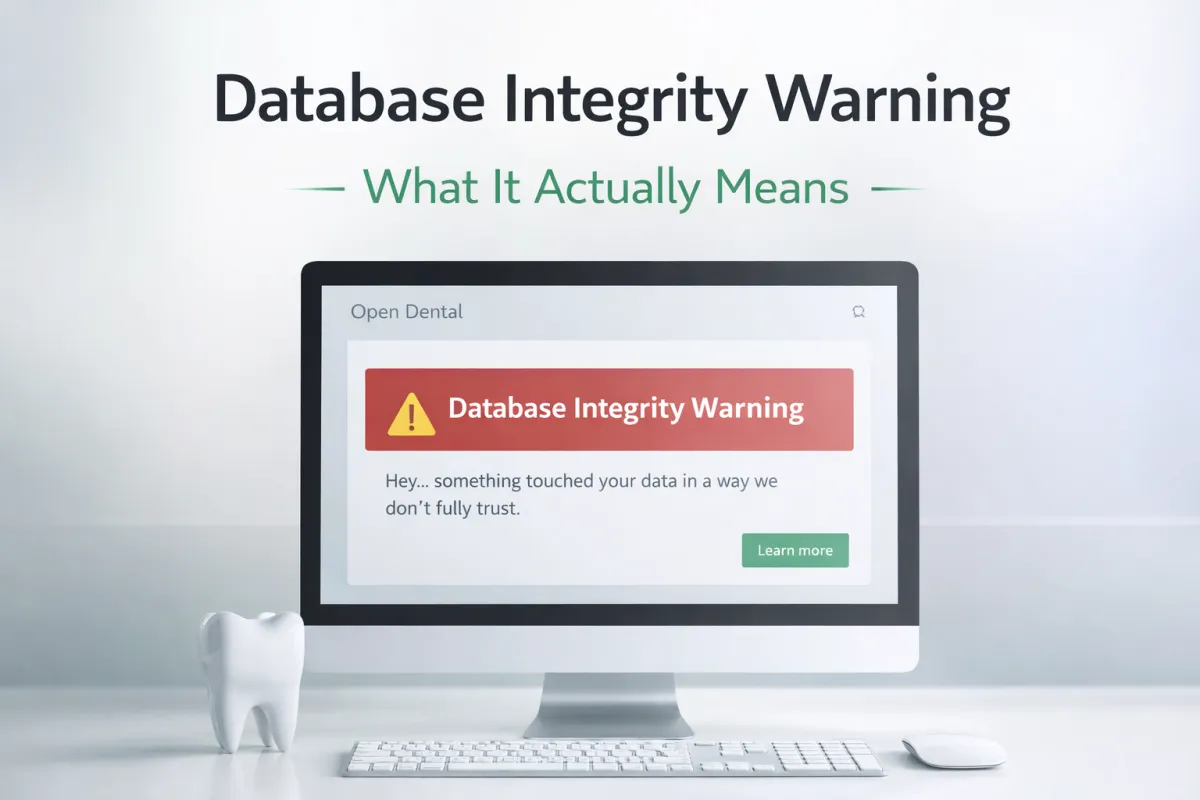
Open Dental Database Integrity Warning, What It Means and What to Do
Why You’re Seeing That New Open Dental Warning, And What It Actually Means
If you logged into Open Dental today and suddenly started seeing a warning pop up… you’re not alone. And no, your database didn’t randomly break overnight.
Let’s slow this down and make it make sense.
What is this new warning?
Open Dental just turned on a new Database Integrity warning.
In plain English…
It’s Open Dental saying: “Hey… something touched your data in a way we don’t fully trust.”

That’s it.
It’s not yelling at you. It’s not saying your system is broken. It’s just raising its hand like… “this might be worth looking at.”
Why is this happening now?
This isn’t actually new behavior… it’s just newly visible.
Open Dental has been pushing vendors for years to use safer ways to connect to your database. Now they’re starting to flag the ones that aren’t.
So if you’re seeing this warning, it usually means:
👉 A third-party software connected to your system
👉 And it added or changed data in a way Open Dental can’t track safely
The simplest way to understand it
There are basically two ways software can interact with Open Dental:
1. The safe way (what Open Dental wants)
Using their API
Think: using the front door, with a key, and a security camera
2. The risky way (what triggers the warning)
Writing directly into the database
Think: climbing through a window… no record of who came in or what they touched
That second one is what causes the warning.
Why this actually matters
Here’s the part people tend to brush off… don’t.
When something writes to your database the unsafe way:
You can’t see it in your audit trail
Open Dental support may not be able to fix issues
It can break with updates
Worst case… it opens the door for data errors or fraud
That’s why Open Dental is tightening this up. Not to be annoying… but to protect your data.
So what should you do if you see the warning?
Don’t panic… but don’t ignore it either. Here’s your move:
Step 1: Identify what software your office is using. Think dashboards, communication tools, AI tools, payment platforms, etc.
Step 2: Check if they’re using a safe integration. Open Dental keeps a running list here:
👉 https://www.opendental.com/site/vendorsthirdparty.html
Step 3: If something looks questionable reach out to that vendor and ask: “Are you using the Open Dental API?” If they hesitate… that’s your answer.
A quick reality check on your tech stack
Not all integrations are created equal.
And this is where offices get into trouble… stacking a bunch of tools without knowing how they actually connect.
If you’re building a clean, future-proof system, you want vendors who are doing it the right way.
💡 On our side, tools like Flex and Daydream are part of our ideal tech stack because they align with safer integration practices.
That doesn’t mean they’re the only ones… but it does mean this matters more than ever when choosing software.
Can you just turn the warning off?
No… not directly.
This isn’t a setting you can toggle off inside Open Dental.
The only way to stop the warning is to remove or fix the source causing it… which is typically a third-party software using an unsafe integration.
If the warning is showing up, something in your system isn’t clean.
Ignoring it doesn’t make it go away… it just means the issue is still there in the background.
Coach moment (because this is important)
A lot of offices are going to try to “work around” this.
That’s the wrong move.
If this warning is popping up in your system, it’s doing you a favor. It’s exposing something you didn’t know was happening.
That’s exactly the kind of stuff that causes:
reporting issues
weird balances
broken workflows
and the “Open Dental is glitching” complaints
…when really, something else touched the data.
Final thought
This isn’t Open Dental being dramatic.
This is Open Dental saying:
👉 “We need to know who is touching your data, and how.”
And honestly… that’s a good thing.
Because the more your systems grow, the more important it is to protect what’s happening behind the scenes.
