Open Dental Case Acceptance & AR Follow-Up Guide
Where Your Revenue Actually Disappears: Case Acceptance and AR Follow-Up in Open Dental
If errors one and two are about what's happening behind the scenes, errors three and four are the ones you feel in real time. One shows up in the operatory. The other shows up in your AR report.
Error Three: Case Acceptance Is Low, So We Need Better Training
This one comes up in almost every conversation I have with a struggling practice. Case acceptance is low, so the team goes to a communication or sales training, works on scripting, coaches the front desk on presentation. Sometimes it helps a little, temporarily. Then someone new comes in and case acceptance drops right back down, and the new person gets blamed.
Before we ran their comp exam, we did what we call a shadow day at one practice, we just sat and watched how it actually ran. What we found was that treatment planning was being done manually, around Open Dental instead of inside it, even though they had everything they needed. The treatment plan module was fully customized. Insurance verifications were being done, and they were even outsourcing and paying for that. The treatment finder, planned appointment report, and task workflows were all configured correctly. Nobody on the team knew any of it was there.
Nobody was doing anything wrong on purpose. They were working around a tool they didn't know how to use or trust. Every time they presented treatment, someone had to grab a calculator and manually work it out, live, in front of the patient. The entire conversation, and all the trust built over the appointment, was at the mercy of whoever happened to be running that calculator.
Here's what makes this so expensive. You hire a great front desk person. Patients love her. She follows up on treatment, case acceptance is solid. Then she leaves, and suddenly case acceptance drops, the recall list stops getting worked, the unscheduled list stops getting worked, and the doctor asks what changed. Nothing changed. The system was always fragile. It just never showed until the person carrying it in her head walked out the door.
It's like handing someone a fully stocked toolbox, every tool they'd ever need, organized and ready, but never showing them what any of it is for. So they improvise. They make do. And the toolbox just sits there, fully loaded, mostly unused. That's what Open Dental's treatment planning tools look like in most practices.
Check your Open Dental Self-Audit under charting and workflow, specifically recall list cleanliness. If it's flagged as anything other than "looking good," you've got unbooked hygiene revenue sitting on that list right now that could be followed up on automatically.
Error Four: They Should Be Staying on Top of This
I want you to be honest with yourself for a second. If your AR is high right now, is some part of you, even quietly, blaming your team? They should be following up more. They should be staying on top of this.
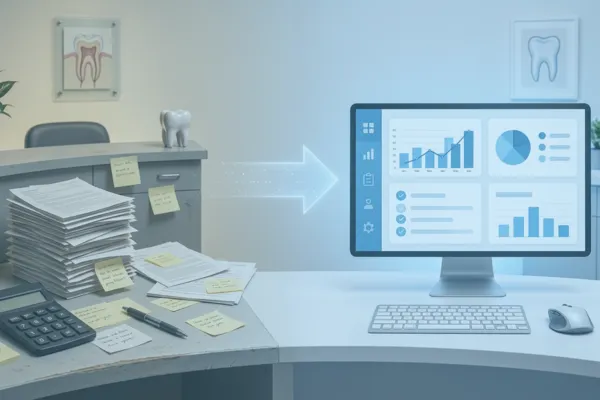
That belief is costing you. Open Dental has the capability to run a fully systematic claims follow-up process. Custom tracking statuses that tag every claim by where it is in the process. Task messaging that routes aged claims to the right person automatically. Custom queries that pull claims by aging bucket. KPI dashboards that track performance over time. In most practices, none of it has been built out. So the front desk is manually tracking hundreds of claims and balances in their head, or on a spreadsheet somewhere. Claims fall through. Others miss timely filing limits entirely. Patient balances sit for ages. AR grows. Your team is trying so hard, but eventually it's like drinking from a fire hose, and they start to burn out.
That same AR-aging practice from our last post saw their insurance AR go from $99,000 down to $36,000 once real infrastructure was in place. And remember the heavy ortho practice from our first post? After we implemented 14-day follow-up cycles, denial management protocols, and custom queries for claims tracking, their claims over 30 days dropped 82% and monthly collections rose 54%. The billing team didn't change. The infrastructure did.
Think about hiring someone to manage a warehouse with no labeling system, no shelving organization, no scanner, no digital log. Just one person walking the floor trying to track thousands of items by memory. They work hard, they stay late, they really try. Things still get lost. That's not a people problem. That's an infrastructure problem, and it's exactly what's happening inside most AR workflows.
Pull up your self-audit and check outstanding insurance claims over 30 days, and your claim custom tracking statuses. If either is flagged, there's money sitting with insurance carriers right now, and no real system dictating what gets worked and when. Those two things together are how AR climbs past the point most practices can recover from on their own.
Last post in this series covers the error that makes all four of these worse the moment someone on your team walks out the door, and what an actual fix looks like from the ground up.