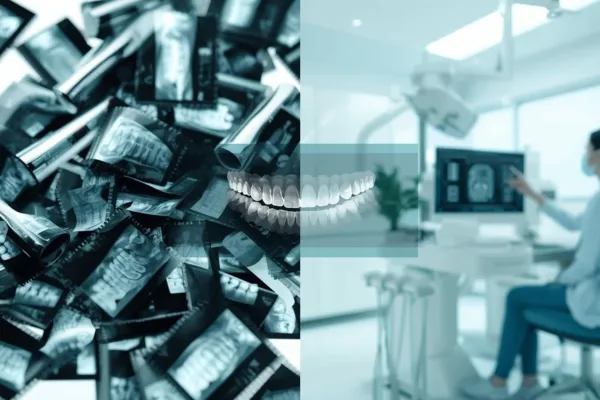
ADA Dental X-Ray Guidelines, What “Only When Necessary” Means
New ADA Dental X-Ray Guidelines: What “Only When Necessary” Actually Means
Let’s talk about dental X-rays.
Because if you’ve ever sat a patient in the the chair who asked, “Did I really need these X-rays?”, you’re not alone. And lately, a lot of headlines and social media posts have made that question feel louder than usual.
In early 2026, articles circulated claiming that the American Dental Association (ADA) had “updated” its dental X-ray guidelines for the first time since 2012, with the takeaway that X-rays should only be taken when clinically necessary.
Here’s the important part, though:
That principle is not new.
And nothing about this update takes decision-making power away from dentists.
So let’s clear up the confusion.
What Was Actually Published in 2026
What sparked the recent conversation was a Journal of the American Dental Association (JADA) article from an expert working group that builds on the existing 2012 ADA/FDA document, Dental Radiographic Examinations: Recommendations for Patient Selection and Limiting Radiation Exposure.
That 2012 document is still the foundational guidance referenced by the ADA today.
The newer JADA publication primarily adds evidence-based recommendations around the use of CBCT (3D imaging), not a sweeping overhaul of how or when routine dental radiographs should be taken.
As dental compliance expert Greg Grobmeyer explained:
“ALARA (As Low As Reasonably Achievable) has been the guiding principle behind dental radiographs for decades. Nothing in the new article changes what should already be happening in dental offices.”
In other words, this wasn’t a reset.
It was a refinement.
Clinical Judgment Has Always Come First
One concern raised in online discussions was whether these recommendations would limit dentists’ ability to make independent clinical decisions or affect reimbursement.
They don’t.
Both the original 2012 ADA/FDA guidelines and the recent JADA publication explicitly state that radiographic recommendations:
Are not a substitute for clinical judgment
May not apply to every patient
Should only be used after reviewing health history and completing a clinical exam
Radiographs must still be:
Prescribed for a documented clinical reason
Of diagnostic quality
Reviewed by the dentist
That has not changed.
“Only When Clinically Necessary”, What That Really Means
This phrase has caused the most anxiety, but it’s worth unpacking.
“Only when clinically necessary” does not mean:
No X-rays
Fewer X-rays across the board
Skipping diagnostic imaging
It means intentional X-rays.
Radiographs should be taken after:
Reviewing medical and dental history
Evaluating existing images
Completing a clinical exam
Considering disease risk factors like decay, periodontal disease, trauma, infection, or symptoms
As Greg Grobmeyer puts it, need can only be determined after an exam, not by reimbursement schedules or routine habits.
X-rays are a diagnostic tool, not a checkbox.
Let’s Talk About Radiation (Because Everyone Thinks About Radiation)
This is usually where concern shows up, and the data remains reassuring.
For perspective:
Four bitewing X-rays taken once per year expose a patient to about 0.005 millisieverts (mSv)
A banana delivers roughly 0.001 mSv due to natural potassium
Dental imaging accounts for less than 1% of total medical radiation exposure in the U.S.
Low dose doesn’t mean careless, it means informed, measured use.
Lead Aprons, Thyroid Collars, and Modern Imaging
Another topic getting attention is the ADA’s updated position on routine shielding.
With modern digital imaging, radiation exposure is already significantly reduced. In some cases, shielding can interfere with the image and lead to retakes, which ironically increases exposure.
Two important clarifications:
Many state regulations still require lead aprons, and those rules must be followed
This reflects evolving science, not reduced concern for safety
The goal remains the same: clear images, fewer retakes, and smarter use of technology.
ALARA Still Applies. Always.
Nothing in the 2026 discussion changes the dentist’s responsibility to follow the ALARA principle, As Low As Reasonably Achievable.
That includes:
Using digital imaging
Limiting the X-ray beam to the area of interest
Avoiding duplicate imaging
Reserving CBCT for cases where lower-dose options won’t provide adequate information
Customizing imaging decisions to each patient, especially children
This has been, and remains, the standard of care.
The Bottom Line
The recent conversation around ADA dental X-ray guidance hasn’t introduced a new philosophy. It has reinforced an existing one.
Dental X-rays should always be:
Based on clinical need
Guided by risk and exam findings
Ordered using professional judgment
Taken with patient safety in mind
As Dr. Grobmeyer emphasized, nothing about this update changes what responsible practices should already be doing.
When it comes to dental imaging, the goal isn’t fewer X-rays.
It’s the right images, at the right time, for the right reasons, exactly as it has always been.